Meta Description: Discover how UAD 3.6 reshapes property data collection for desktop and hybrid appraisals. Learn what changes, what stays the same, and how to stay compliant.
Introduction: The Data Collection Question Nobody Is Asking Loudly Enough
Every conversation about UAD 3.6 eventually lands on software upgrades, XML output, and GSE delivery timelines. Those are important. But there is a more fundamental question that deserves attention: where does the data actually come from?
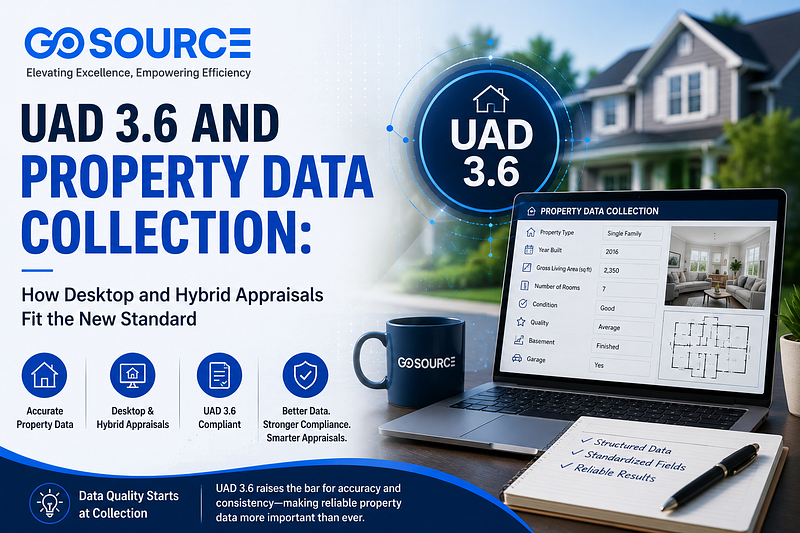
Property data collection in the process of gathering, verifying, and recording the physical attributes of a home sits at the very beginning of the appraisal workflow. And with UAD 3.6’s strict field-level standardization, whatever data enters the system at collection determines the accuracy, completeness, and compliance of everything that follows.
This is especially relevant now that desktop appraisals and hybrid appraisals have become mainstream. These assignment types separate the data collection function from the appraiser’s analysis, creating new dependencies and new risks under the UAD 3.6 model.
If you are trying to understand the full scope of what UAD 3.6 means for your workflow, property data collection is the piece that often gets overlooked — and the piece most likely to cause problems if ignored.
What UAD 3.6 Actually Demands from Property Data
Under the legacy appraisal model, a lot of property data lived in free-text fields. Appraisers described conditions, quality, features, and amenities in whatever language felt natural. This created an inconsistency that was invisible inside any single report but became a major problem at scale when GSEs tried to aggregate and analyze appraisal data across thousands of loans.
UAD 3.6 closes that gap. Every data point must conform to defined field types of string, numeric, Boolean, and date, with no room for hybrid entries. Standardized allowable values mean condition and quality ratings use specific codes, not free-form language. Validated relationships ensure that if a field says a property has a basement, related fields about finish and square footage become required. Consistent terminology is enforced at the system level.
This means property data collection is no longer just about observation. It is about structured data capture. Whatever is recorded in the field or remotely must map cleanly to UAD 3.6’s data model before it ever reaches the appraiser desk for analysis.
Desktop Appraisals and UAD 3.6: The Remote Data Challenge
Desktop appraisals, where the appraiser analyzes a property without a physical inspection, relying on existing data sources, have grown significantly since the GSEs expanded their use. Under UAD 3.6, these assignments require additional attention because data inputs come from third-party sources rather than direct observation.
Acceptable sources for desktop appraisals include MLS listing data and photographs, public records and county assessor data, prior appraisal reports, aerial imagery and mapping tools, and approved property data collection platforms. Each of these has varying levels of reliability and varying UAD 3.6 field compatibility. An appraiser completing a desktop assignment must evaluate not just whether the data is available, but whether it is precise enough to satisfy UAD 3.6’s structured requirements.
The most common risk is data gaps. A property listed in MLS three years ago may have condition ratings and room counts, but not in the format or detail level UAD 3.6 requires. When the appraiser enters this data into a compliant system, real-time validation will flag incomplete or non-conforming entries immediately.
The second risk is data accuracy. Without a physical inspection, there is no direct verification. If public records reflect an outdated configuration, a finished basement added after the last permit, or an addition not captured in the assessor file, the UAD 3.6 report will reflect that error unless the appraiser identifies and flags the discrepancy. Errors that once passed through PDF review unnoticed now trigger automated validation flags that delay processing and require correction.
Hybrid Appraisals and UAD 3.6: When Data Collection Is Separated from Analysis
Hybrid appraisals go further by formally separating the inspection from the analysis. A property data collector (PDC), typically a trained third-party inspector, real estate agent, or technology platform operator, visits the property, records measurements, documents conditions, and captures photographs. That data is then handed off to the licensed appraiser for analysis and valuation.
Under the old model, the PDC’s job was largely descriptive: take photos, measure rooms, and note obvious conditions. The appraiser would translate that narrative into an appraisal form of language.
Under UAD 3.6, the data the PDC collects must map directly to structured data fields. Measurements must follow specific protocols. ANSI Z765 is the relevant standard for residential square footage. Condition observations must use terminology that aligns with UAD 3.6’s allowable values. Feature presence or absence must be recorded at the field level, not summarized in a narrative.
This raises the bar for property data collectors significantly. A PDC that records data in a loose descriptive format creates rework at the appraiser level when that data needs to be translated into UAD 3.6-compliant fields. The most efficient hybrid workflows will have PDCs working in tools purpose-built to capture UAD 3.6-ready data from the start.
For AMCs managing hybrid appraisal volume, the choice of PDC platform is now a UAD 3.6 compliance decision, not just an operational one. Platforms that produce UAD 3.6-compatible data reduce friction, reduce errors, and reduce the revision cycles that slow down loan processing. The Go Source Valuation blog covers related AMC operational topics, including quality control and workflow strategy.
What Appraisers Need to Know About Working with PDC Data Under UAD 3.6
When data collection and analysis are separated, the appraiser’s responsibility does not diminish it shifts. The appraiser remains the licensed professional responsible for the credibility of the report. Under UAD 3.6, that responsibility includes three things.
First, validate the PDC data before relying on it. Before populating UAD 3.6 fields based on PDC-collected data, review the collected data for completeness, internal consistency, and alignment with secondary sources. Discrepancies should be flagged and resolved.
Second, understand the data source hierarchy. UAD 3.6-compliant software requires documentation of data sources at the field level for certain data points. Appraisers need to know how to correctly attribute data to its source, PDC inspection, MLS, and public records within the system.
Third, manage validation errors efficiently. When PDC data generates validation errors during entry, appraisers need clear protocols: when to correct, when to override with explanation, and when to request updated data from the collector.
Practical Steps to Align Property Data Collection with UAD 3.6
For Appraisers: Review UAD 3.6 field specifications for property data points most captured through PDC or remote sources. When accepting hybrid assignments, verify that the PDC used a UAD 3.6-compatible collection tool before accepting the data package. Build a minimum data requirements checklist for hybrid assignments that match UAD 3.6 field-level requirements.
For AMCs: Evaluate your PDC vendor relationships through the lens of UAD 3.6. What data format do they produce, and how does it map to UAD 3.6 fields? Consider requiring PDC platforms that produce structured, importable data outputs rather than PDF-based inspection reports. Update the hybrid appraisal workflow documentation to specify UAD 3.6 data requirements at the collection stage.
For Lenders: Understand that the quality of the desktop or hybrid appraisal you receive is increasingly a function of upstream data collection quality. Include UAD 3.6 data collection standards in your AMC and appraiser panel requirements.
The Bigger Picture: Data Quality Starts at Collection
UAD 3.6 is fundamentally about data quality, structured, standardized, validated data that flows seamlessly through the mortgage ecosystem without manual intervention. But that quality does not originate from the software. It originates from a collection.
Desktop and hybrid appraisals are a growing share of the residential appraisal market. As that share grows, the question of where the data comes from and how reliably it meets UAD 3.6 requirements will become one of the central operational challenges for every firm in the appraisal chain. The firms that align their collection tools, PDC training, and review protocols with UAD 3.6 requirements now will be the ones processing clean, compliant reports when the standard becomes mandatory.
Frequently Asked Questions
Q: Does UAD 3.6 apply to desktop appraisals? Yes. UAD 3.6 governs how appraisal data is structured and delivered regardless of the inspection method. Desktop and hybrid assignments must produce UAD 3.6-compliant output.
Q: Who is responsible for UAD 3.6 compliance in a hybrid appraisal? The licensed appraiser remains responsible for the credibility and compliance of the final report. However, the quality of the PDC data directly affects how efficiently compliance is achieved.
Q: What happens if PDC data does not meet UAD 3.6 field requirements? UAD 3.6-compliant software will flag incomplete or non-conforming entries during real-time validation. The appraiser will need to resolve those flags before submission, which may require additional data from the collector.
Q: Are there approved platforms for UAD 3.6-compatible property data collection? GSEs have issued guidance on acceptable data collection methods and approved technology platforms. Firms should monitor official Fannie Mae and Freddie Mac communications for current tools and protocols.